
A new House bill, H.R. 9721, would put individual sponsored projects on public display and attach real tax penalties to conduit arrangements. The more interesting story is what it doesn't change.
Fiscal sponsorship has operated for decades without a definition anywhere in the Internal Revenue Code. On July 16, 2026, Rep. Lloyd Smucker (R-PA) gave Congress a reason to fix that. His bill, H.R. 9721, the Fiscal Sponsorship Transparency Act of 2026, would write fiscal sponsorship into federal tax law for the first time, put individual sponsored projects on display inside a sponsor’s own Form 990, and attach real dollar penalties to arrangements where a charity is, in substance, just handing money through.
Six days later, on July 22, the House Ways and Means Committee approved the bill by a vote of 23–15. A Senate companion, S. 5083, arrived from Senator Tom Cotton’s office that same afternoon.
None of that changes what your organization owes the IRS today. But the bill is worth thirty minutes of your attention, because the standard doing the real work inside it isn’t new at all, and the questions it asks are ones a properly run fiscal sponsor should already be able to answer without breaking a sweat.
Before anything else, a reality check, because a fair amount of what’s already circulating overstates where this bill is:
Strip away the politics, and the bill’s mechanics are fairly narrow. For each arrangement covered by the bill's own definition of a "fiscal sponsorship arrangement," a sponsor's Form 990 would need to disclose:
Notice what's absent: the bill wouldn't create a new federal return just for the sponsored project. The required information would show up on the sponsor's own Form 990 instead, closer to an itemized schedule than a spotlight aimed directly at the project. (A separately incorporated sponsored project can still have its own filing obligations under other rules; this bill doesn't touch those.)
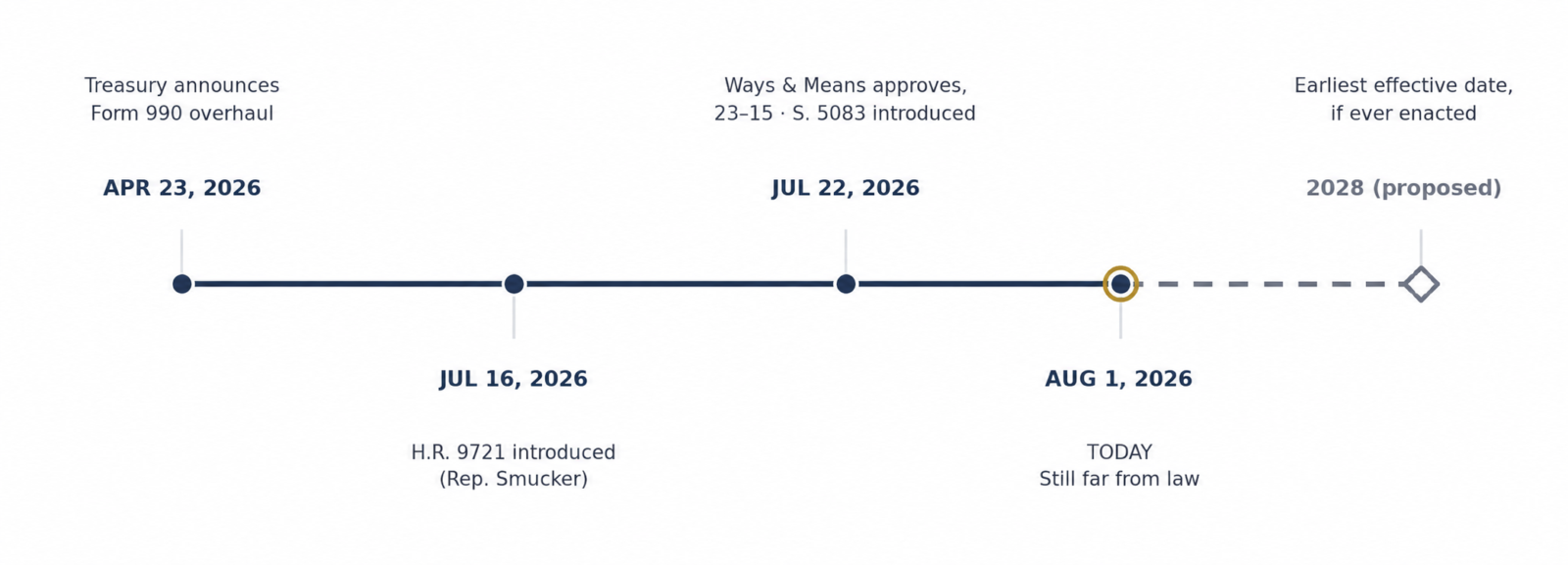
How we got here and how far there still is to go before any of this is binding.
Here’s what most of the instant commentary on this bill is missing: the legal principle it’s actually built around – discretion and control – isn’t something H.R. 9721 invented. It’s a standard the IRS has applied for decades. Revenue Ruling 68-489 confirmed in 1968 that a Section 501(c)(3) organization can distribute funds to non-exempt organizations without jeopardizing its exemption, provided it retains control and discretion over their use for exempt purposes.
A properly run fiscal sponsor:
An organization doing that work is not a pass-through, no matter how a casual observer outside the relationship might describe it. H.R. 9721 doesn’t move that line. It’s trying to make the line show up on paper, where a regulator or a reporter can actually see it.
Two things in this bill are new in their own right. A third writes a much older principle into the statute for the first time, without necessarily making it any easier to trigger.
1. Project-level visibility.
A sponsor’s Form 990 currently doesn’t have to itemize its sponsored projects one by one. This bill would change that: donors, journalists, and rival organizations would all be able to see individual arrangements, not just an aggregate number buried in a footnote.
2. Explicit tax penalties.
For what the bill calls an "improper conduit arrangement" — soliciting or receiving funds earmarked for a specific, non-exempt recipient, without genuinely exercising discretion and control — the committee-approved text imposes a 20% excise tax on the organization for any amount knowingly transferred under the arrangement. If the transfer isn't corrected in time, an additional tax equal to 100% of the amount can apply on top of the initial 20%. That second-tier tax is avoidable if the transfer is corrected within the statutory period. The bill defines correction primarily as recovering the transferred amount to the extent recovery is possible; if full recovery isn't possible, Treasury would prescribe by regulation what additional corrective action is required. Organization managers who knowingly sign off on an improper transfer face their own tax too, smaller and capped, but real.
3. A donor deduction risk, now written into the statute.
The IRS has treated true conduit arrangements as non-deductible for donors since at least 1962, under Revenue Ruling 62-113: if an organization doesn't have real control and discretion over a gift, the IRS can treat it as a gift to the ultimate recipient instead, and disallow the deduction. That part isn't new. What the bill adds is a direct statutory hook: it would write the same disallowance into IRC §170(c) itself, tied to the bill's own definition of an "improper conduit arrangement" – the same definition that also triggers the new excise tax. That doesn't obviously make the standard easier to fail than it is today: the central question, whether the sponsor actually exercised discretion and control, stays a facts-and-circumstances call, and the bill itself directs Treasury to issue regulations spelling out what "discretion and control" means. What changes is where the rule lives, in the Code itself, not only in decades of revenue rulings, and that one definition now decides both whether a donor keeps the deduction and whether the sponsor owes the excise tax.
This bill's timing traces in large part to one case. In October 2024, the Treasury Department designated Samidoun, an organization that had raised money in the United States through a fiscal sponsorship arrangement with the Alliance for Global Justice, as a "sham charity" that served, in Treasury's words, as an international fundraiser for the Popular Front for the Liberation of Palestine, a group the State Department designated a foreign terrorist organization back in 1997. Ways and Means Republicans had already pressed the IRS to revoke the sponsor's tax-exempt status over that arrangement: once in September 2024, before the designation, and again that November. Rep. Smucker has pointed to the case directly, citing the lack of any uniform public reporting requirement that kept arrangements like Samidoun's from being readily visible to the public. Committee Chairman Jason Smith made the specific gap explicit at the markup: Alliance for Global Justice, he said, was never required to disclose Samidoun by name on its Form 990.
That sequence is a central part of why this bill exists, and why it went from introduction to committee passage in just six days. But the text Congress actually wrote doesn't target any particular cause. Its reporting provisions turn on the bill's definition of "fiscal sponsorship arrangement," and its penalty provisions turn on a separate definition, "improper conduit arrangement" – and neither one distinguishes by subject matter. A global-health project, a mutual aid fund, or a local arts collective would be judged by the same statutory elements as a case like Samidoun's. That gap, between a narrow motivating example and a broad statutory test, is exactly what's driving the concerns below.
This isn’t a story about the nonprofit sector simply resisting transparency for its own sake. Independent Sector and nonprofit attorneys (Gene Takagi among the most vocal) have raised concerns worth taking seriously, not dismissing as reflexive defensiveness:
None of this means the underlying goal is misguided. Greater visibility into how charitable dollars move is a legitimate thing for Congress to want. But definitions, thresholds, and implementation details are precisely where a reasonable bill can turn into an unreasonable one. And right now, some of those details remain unresolved.
None of this calls for panic, and nothing here is due yet. But it's a good moment for a fiscal sponsor to ask itself the questions this bill would make much more important — including several it could eventually have to answer publicly.
If you're a fiscal sponsor, it's worth checking two things separately: what the bill would eventually make public, and what good practice already expects of you regardless of what Congress does.
What the bill would eventually make public:
What good fiscal sponsorship practice already expects, bill or no bill:
If you're a sponsored project:
Even if H.R. 9721 stalls, and a party-line committee vote isn't an encouraging place to start building the bipartisan support a standalone bill may need to overcome a Senate filibuster, the underlying story isn't going away. On April 23, 2026, months before this bill was introduced, the Treasury Department announced that the IRS intends to revise Form 990 itself to bring clearer reporting to exactly this kind of arrangement, alongside government grants and contracts. Proposed regulations and a public comment period are expected before anything is finalized.
So the paths forward multiply rather than narrow. Treasury and the IRS could revise Form 990 administratively, with or without this bill. This version of H.R. 9721 could get reworked again before it ever reaches the House floor — it already was once, when the committee adopted its own substitute at markup. It could die quietly in this Congress and reappear, largely unchanged, in the next one. Or pieces of it could resurface, folded into a much larger tax package down the road.
The specific vehicle may change shape more than once before this is settled. What already looks like it's taking shape, regardless of which vehicle gets there first, is a simple expectation: that a fiscal sponsor should be able to name its projects, trace its charitable dollars, and show, not just say, that someone is actually in control of them.
The mandatory project-by-project public naming is new. Tracing the dollars and proving real control were always the job. Someone is about to start checking the paperwork — Congress, Treasury, or both. We’ll keep you updated as this develops.
This article is for informational purposes only, reflects developments as of August 1, 2026, and does not constitute legal advice.
About the Author
Alex Davis is a founding member of Omni Law P.C. and serves as Board Chair at Group 36. His work focuses on strategic legal guidance around deal structures and complex transactions, with experience advising startups, established companies, investors, and executives across multiple industries. He has held in-house counsel roles in the media industry and is admitted to practice in California, New York, New Jersey, and Pennsylvania.
Sources & Further Reading