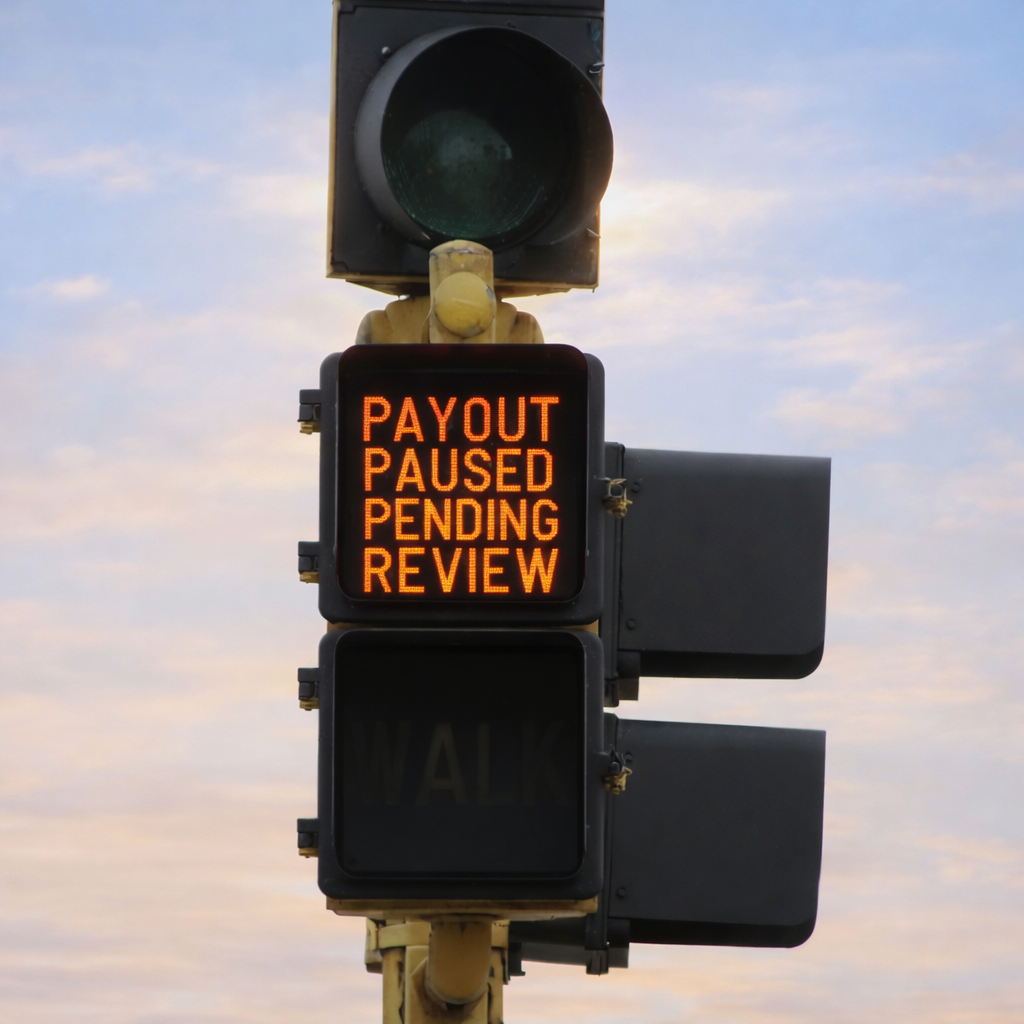
Fundraising platform risks rarely show up on the planning slide. They show up on a Tuesday morning – right when your campaign finally has momentum.
A nonprofit launches a giving page. The story resonates. Donations come in steadily, then surge after a partner reposts. The dashboard looks great, and the campaign lead starts mapping what the money will fund this month.
And then the email arrives: “Payout paused pending review.”
Nothing about that message feels dramatic. It’s a template, probably automated. But operationally it can be devastating: payroll is due, a vendor expects payment, a beneficiary is waiting, and the organization suddenly has a cash-flow problem even though donors already gave.
This is why fundraising platform risks deserve a real spot in 2026 planning – not as paranoia, but as basic financial stewardship. Online fundraising has stabilized after the post-pandemic swing: the M+R Benchmarks report found average online revenue rose 2% in 2024, and monthly giving grew 5%, reaching 31% of online revenue. That’s not a fringe channel anymore; it’s core infrastructure.
At the same time, the broader environment is noisier: the FBI reported losses exceeding $16 billion in 2024 from internet crime complaints – an ecosystem where fraud attempts, impersonation, and disputes are increasingly normalized.
If fundraising platforms are part of your revenue mix, these are the risks that matter most – and what “good” looks like operationally.
Platform exposure is one slice of a wider picture — see also the five risks nonprofits were not tracking in 2025.
The most common high-impact problem in platform fundraising is not a scandal. It’s friction.
A hold can happen because a payment processor’s risk model flags something: a sudden spike in volume, an unusual pattern of card types, a mismatch between the campaign narrative and the legal entity, an incomplete identity verification step, or a donor dispute wave that pushes your profile into a higher-risk bucket. In many cases, the nonprofit did nothing “wrong.” The system simply does what it was designed to do: reduce exposure.
The challenge is that operational reality doesn’t care whether the hold is justified. You can’t pay bills with “pending.”
This risk intensifies for smaller organizations and fiscally sponsored projects because the “who is who” question becomes harder: who controls the account, whose bank account receives funds, who is the legal donee, and what name appears on donor statements. If those elements are unclear – or change mid-campaign – you create exactly the sort of inconsistency that automated reviews treat as suspicious.
A key point most people miss: platforms and processors evaluate not only fraud, but also disputes. Visa’s monitoring framework explicitly links fraud and disputes into a single ratio and flags “excessive” merchant behavior at defined thresholds. Even if you never think of yourself as a “merchant,” in card-not-present fundraising you are effectively operating in that ecosystem.
Chargebacks are emotionally frustrating because they feel unfair. A donor gave voluntarily. The impact story is real. Why would the donation be reversed?
In practice, disputes are often mundane: a spouse doesn’t recognize the descriptor; a donor forgot they gave; someone clicked the wrong amount; or a scammer used a stolen card and the real cardholder reversed the transaction. Whatever the reason, disputes cost time and money – and they can trigger holds and higher fees.
Even large platforms treat disputes as a daily operational category. Stripe, for example, publishes guidance on chargeback dynamics and tracking chargeback rates because they are central to payment risk management.
For nonprofits, the issue is not only the immediate loss. It’s the compounding effect: dispute waves can degrade your “trust score,” slow future payouts, and force you into manual review loops that are hard to escape during an active campaign.
This is why the most effective “chargeback prevention” is often not a legal policy – it’s clarity:
clear naming/branding that matches what appears on the bank statement,
a confirmation email that makes the gift feel unmistakable,
and a fast, human response when donors ask questions.
When donors can’t get a quick explanation, they don’t wait. They dispute.
One of the fastest ways to damage credibility is to mishandle receipts – especially for donations of $250+.
The IRS is explicit: a donor can deduct a charitable contribution of $250 or more only if the donor has a written acknowledgment from the charitable organization, containing specific required elements. The IRS’s Publication 1771 lays out what an acknowledgment should include and clarifies that without it, the donor may be unable to claim the deduction – even though the gift was legitimate.
This becomes especially sensitive in platform giving, where donors may receive a platform-generated receipt that looks official but doesn’t always meet best practice for substantiation (or doesn’t reflect the right legal entity when fiscal sponsorship is involved). If a donor is confused about who the donee is – and the acknowledgment doesn’t match – the donor’s confidence drops, and so does the chance of repeat support.
In 2026, donors are also more likely to ask, “Is this still tax-deductible?” because policy changes and headlines keep shifting their perception. Your receipt workflow is part of answering that question.
The operational fix is simple in concept but requires discipline: decide, in advance, who issues the acknowledgment(platform, nonprofit, fiscal sponsor), ensure the language is correct, and test it end-to-end like you would test a donation form.
For years, many nonprofits treated platforms as “just technology.” Regulators increasingly treat them as part of the fundraising system – and therefore part of the compliance perimeter.
California’s AB 488 and its implementing regulations created a distinct framework for charitable fundraising platforms and platform charities, with registration and reporting expectations tied to solicitations reaching Californians.
Even if your organization is not based in California, online fundraising can still touch CA donors. The risk here is not that every nonprofit will suddenly be audited. The risk is operational: if your platform’s compliance posture changes (or a platform tightens eligibility rules), your campaign can be interrupted without much warning.
This is another reason “platform diversification” is not just a marketing idea. It is risk management.
Fundraising platform risks also include threats that are not under your control: impersonation, fake campaigns, and disaster-related fraud.
The FBI has issued public warnings about charitable fraud, noting that in 2024 the Internet Crime Complaint Center received more than 4,500 complaints and reported roughly $96 million in losses tied to fraudulent charities, crowdfunding accounts, and disaster relief campaigns.
Separately, the broader scam environment is accelerating. Pew Research summarized FBI data showing $16.6 billion in losses reported to the FBI for 2024 internet crime, reinforcing how common fraud attempts have become.
The implication for real nonprofits is uncomfortable but practical: donors are increasingly primed to suspect scams, which means legitimate organizations must work harder to signal legitimacy. That legitimacy is built through consistency – same name, same story, same receipt logic, same “who gets the money” explanation, and a visible trail of real work.
A nonprofit doesn’t need to become a payments expert to manage fundraising platform risks. It needs a short operating standard – something you can run through before launching a campaign and again when scaling it.
Here is the tight version that actually gets used:
Clarify identities: who is the legal recipient, who controls the account, what name appears on receipts and card statements, and – under fiscal sponsorship – how you describe the relationship consistently.
Pre-build a “hold response” kit: the documents and explanations a platform may request (EIN/registration, bank verification, mission description, beneficiary explanation, fiscal sponsorship documentation where applicable).
Treat receipts as donor experience: test acknowledgments for $250+ gifts; confirm required elements are present; ensure the donee name is correct.
Design for fewer disputes: clear descriptors, immediate confirmation, fast support responses, and a simple refund path for honest mistakes.
Know your platform’s compliance posture: especially if you regularly reach donors in California or run large public campaigns.
None of this makes fundraising less ambitious. It makes it more reliable.
In 2026, fundraising platforms are not just distribution channels; they are part of your organization’s financial infrastructure. The upside is real: online revenue has rebounded modestly, and monthly giving is becoming a larger share of digital fundraising.
But infrastructure has failure modes. Holds, disputes, receipt errors, compliance shifts, and fraud attempts can derail campaigns that are otherwise successful. Treating fundraising platform risks as a first-class operational category is not “extra.” It is how you protect donor trust, preserve cash flow, and keep your mission work predictable even when the internet is not.