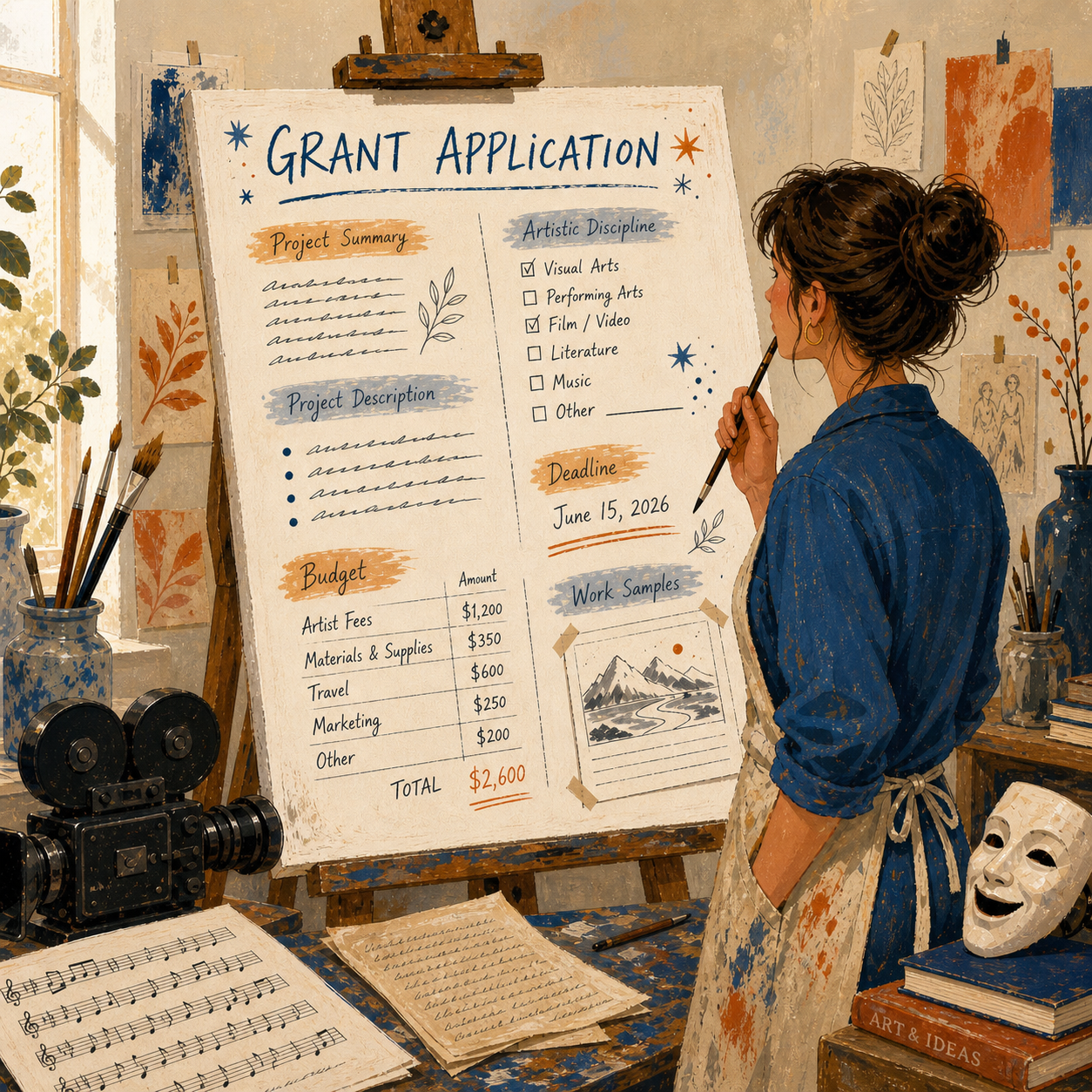
As a creative soul, have you ever wondered whether you could actually get paid, or funded, to expand your craft?
Every year, thousands of creatives receive real money to write the novel, record the album, shoot the documentary, stage the performance, or deepen the studio practice they've been dreaming about for years. Behind nearly every "how did they pull that off?" project you see online, there's usually a grant, a fellowship, or a fiscally-sponsored campaign quietly making it possible. The truth is, funding exists in surprising amounts, much of it reserved specifically for independent artists, small collectives, and projects that don't yet have 501(c)(3) status. Consider this your roadmap to finding it. That's exactly why we built The Creative's Grant Playbook, a free, two-page guide that walks you through the eight things that actually move the needle on a grant application, plus 20 national funders currently supporting creative projects.
The first page covers the craft of applying. We distilled the most common make-or-break factors into eight critical tips — including how eligibility works, what fiscal sponsorship is and why it determines which funders you can approach, and how to separate project expenses from operating costs. why grants fund what's next rather than what you've already done, and how to build a budget specific enough to survive grant reviewers. We also dig into the 300 words of the project statement that do more work than anything else, why work samples beat résumés, how to choose letters of support that add real weight, and why reporting back builds the relationship that leads to the next grant.
Our observations aren't generic. They come from years of sitting on both sides of the table, writing, reviewing, and administering grants for artists and small arts organizations.
The second page is the part creatives tend to bookmark. We've curated 20 active national funders, all currently accepting applications from individuals, small organizations, or fiscally-sponsored projects, and organized them by discipline so you can skip straight to what's relevant to your work.
Multi-disciplinary funders include the NEA's Grants for Arts Projects, Creative Capital, and USA Fellowships. Individual artists can explore FCA and Pollock-Krasner. Musicians will find New Music USA and Chamber Music America; documentary makers will find Sundance Doc, Chicken & Egg, and Jerome. Performance, theater, and dance artists can look at MAP Fund, National Dance Project, and Princess Grace. Visual artists have Artadia and Joan Mitchell; writers have NEA Creative Writing Fellowships and the Whiting Awards. And for emergency needs or one-time projects, we've included micro-grants like the Awesome Foundation, Puffin Foundation, and Rauschenberg Emergency Grants.
Each listing includes a one-line description of who the funder supports and a direct link to its application page, so you can move from "I didn't know that existed" to "I'm marking my calendar" in a single click.
At Group 36, we spend our days helping creative projects access funding they'd otherwise be locked out of, most often through fiscal sponsorship, which lets individual artists and small collectives apply for grants requiring 501(c)(3) status without the overhead of starting their own nonprofit. A surprising number of the creatives we talk to have never heard the term "fiscal sponsor," even though it's often the missing key to their first major grant.