Many early-stage nonprofits and grassroots projects start thinking about fundraising before they have their own 501(c)(3). That’s understandable. The need is urgent, the mission is clear, and waiting can feel like lost momentum.
But this is also when many teams go public before the basic structure behind the campaign is ready. That gap matters.
Your campaign can look active long before it’s actually prepared. The story may be strong. The page may be live. Supporters may be ready to share it. But if the underlying setup is still loose, early momentum can turn into confusion just as quickly as it turns into donations.
When teams think about fundraising before 501(c)(3) approval, they often focus on the legal issue first. That makes sense. Tax-deductible status, donation processing, eligibility, and public language all matter.
But the risk isn’t only legal. It’s also operational. It’s reputational. And in many cases, it’s avoidable.
The problem usually isn’t a weak mission or a careless team. More often, your campaign is moving faster than the structure behind it. You may be emotionally ready to ask for support, but still unclear on how contributions will be handled, what language should be used publicly, how donor follow-up will work, or whether the campaign can hold together once people begin responding.
That’s where early friction begins.
At this stage, many teams assume that if the story is compelling and the cause is real, fundraising can begin. They treat launch as a communications decision: write the appeal, publish the page, start sharing.
But early fundraising isn’t only a communications moment. It’s an operating moment.
Your supporters won’t see every internal detail, but they’ll feel the effects of weak setup almost immediately. A campaign can seem promising and still feel improvised. A supporter may want to give and still hesitate. A potential donor may believe in the cause and still walk away because the structure feels unclear, the message feels rushed, or the overall experience doesn’t inspire enough confidence.
Emerging organizations don’t have much room for that kind of friction. Established institutions sometimes survive clumsy fundraising because they already have recognition and donor familiarity. Early-stage efforts usually don’t. Your first campaign is often part of how legitimacy gets built in the first place.
One common mistake is confusing a donation tool with fundraising readiness.
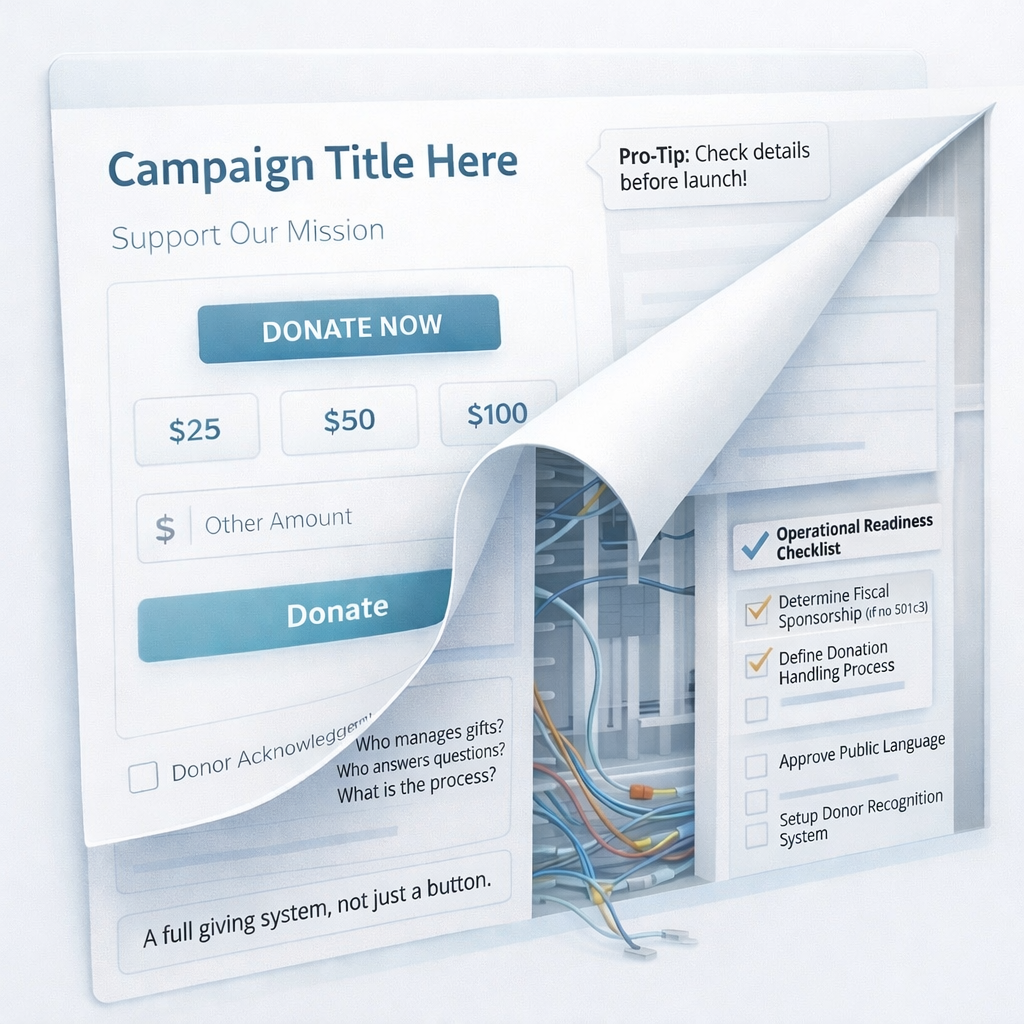
A platform is not a campaign. A donation button is not a full giving system. A public page is not a prepared launch.
Another mistake is assuming that details can be cleaned up later. You tell yourself you’ll tighten the language after launch, clarify responsibilities after launch, improve follow-up after launch, and solve process questions once the campaign has started moving.
But public fundraising rarely makes weak preparation easier to fix. It usually exposes it.
That’s especially true when your project is still waiting for its own 501(c)(3). At that stage, structure matters even more because supporters are already being asked to trust something that is still forming.
Weak preparation doesn’t always show up as a dramatic failure. Often it appears as small signs of uncertainty that quietly reduce momentum.
A donor is interested but not fully sure how their contribution will be handled. A supporter visits your page but doesn’t understand whether the campaign is operating through a fiscal sponsor or another arrangement. Someone gives, but acknowledgment and follow-up are inconsistent. Internal questions begin surfacing at the same time your public campaign is trying to gain traction.
Who is monitoring gifts? Who is answering donor questions? What language is approved? What process is already in place, and what is still being decided on the fly?
None of these questions are minor once a campaign is live. In early fundraising, supporters are not only evaluating the cause. They’re also evaluating whether your effort feels coherent, responsible, and ready to carry support well.
This doesn’t mean you need to wait until everything is perfect. Early-stage initiatives often need to build support while still growing. That’s normal. But there’s a difference between launching while still growing and launching while still guessing.
Before going public, you need a practical way to test whether your campaign’s basic structure is in place. Not in theory. Not in broad intention. At the actual points where campaigns most often become messy once attention arrives.
That kind of review isn’t bureaucracy. It’s preparation.
And for organizations fundraising before their own 501(c)(3) is in place, it can make the difference between a campaign that builds confidence and one that creates preventable friction.
The difference between scrambling and succeeding is often what gets checked before a campaign goes public.
If your organization is preparing to fundraise before its own 501(c)(3) is fully in place, download our “Before You Fundraise” Pro Tips Report for emerging 501(c)(3)s and grassroots campaigns. It’s designed to help you review the readiness issues that are easiest to overlook before launch – and hardest to fix once your campaign is already public.