Fiscal sponsorship is not a pass-through. Every sponsored dollar carries obligations: it has to be received into a compliant account, tracked against its restrictions, receipted to the donor, disbursed only against an approved budget, documented, and reported. That work is continuous, and it is what stands between a charitable gift and a misapplied one.
The 5% to 7% fee is what funds that work. It covers fund controls and segregated tracking, compliance review, donor receipting and acknowledgment, authorization and documentation of disbursements, and the financial reporting that funders and regulators require. Projects also receive the benefit of our existing 501(c)(3) status, insurance posture, and governance structure, none of which they would have to build or pay for separately.
It also covers something harder to put on an invoice: people to ask. The team administering your funds comes from senior finance, operations, marketing, and executive leadership backgrounds, and sponsored projects work with them directly. When a grant agreement contains a clause you have not seen before, when a funder asks for reporting in an unfamiliar format, or when you are not sure whether an expense is allowable, the question has somewhere to go. Most projects would have to hire for that kind of access, or go without it.
As a 501(c)(3) public charity, Group 36 has no owners and no shareholders. Fee revenue supports our charitable purpose and the oversight that every sponsored project receives.
Fiscal sponsorship allows a charitable initiative to operate under the legal and tax-exempt status of an established 501(c)(3) organization.
At Group 36, fiscal sponsorship is not simply administrative. It is fiduciary.
Charitable funds are received, managed, and disbursed within a structured governance framework designed to protect donors, leaders, and intended beneficiaries.
This structure enables fundraising and operations to proceed without forming a standalone nonprofit, while maintaining accountability and compliance.

Without appropriate controls, funds may be delayed, restricted improperly, or misapplied. Reputational and regulatory risk increases.
Every sponsored project asks the same question sooner or later: where does my money stand right now? At Group 36 the answer is a login, not an email thread.
Each project gets a private client portal. One screen shows what has been received, what has been spent, what is available to spend today, and what is pending. Budget sits against actual, line by line. Every payment request carries its vendor, amount, status, and date. There is no reconciling by email and no waiting on a monthly statement.
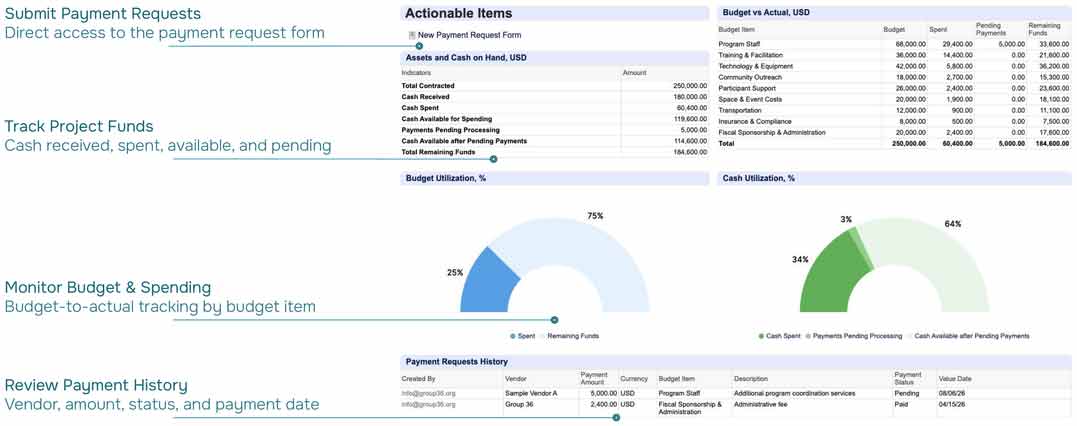
The oversight behind the screen does not change. Donor restrictions are still tracked, disbursements are still authorized against an approved budget, and the reporting funders and regulators require is still prepared. The portal is simply how you watch it happen without having to ask.